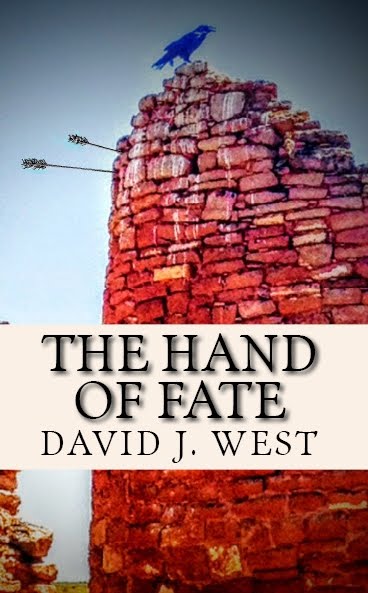
I was saddened to find that a friend had passed away Monday in his sleep, he was only 43. Preston McConkie was outspoken, grumpy and honest. I can think of several times I tried to keep the peace on some facebook posts where he would enjoy commenting something rather inflammatory, in any case I consider him a great friend who helped me quite a lot with my writing even if I didn't know it was him for years.
Randomly chatting on facebook, I found out he was one of the original two slush editors for Zarahemla Books - and he was the unnamed editor one who first gave me some good encouragement despite a rejection. I treasured his comments that Heroes of the Fallen was the best Book of Mormon fiction he had ever read and quite Arthurian.
More recently he helped edit the forthcoming The Mad Song and helped give me some other editing tips on other projects.
I have read several of his short stories and realizing that this short piece was on his blog earlier this year, I decided to share it here.
It was published in the May 2012 issue of eFiction, and getting to know Preston better I found that while it was labeled fiction for the magazine, it was indeed a true experience of his regarding the first Gulf War.
Thank you Preston for your friendship, til we meet again...
Dream Cred
By Preston McConkie
2153 words
I used to think it was a big deal to wake up screaming or swinging.
That’s what the Vietnam vets did. It was a new version of the red
badge of courage. I certainly didn’t expect it to happen to me, and
when it did start it was two years after those 38 days from the Jan.
14 outbreak to the Feb. 25 invasion, then the six days of combat and
the other two days falling back out of Iraq through Kuwait and at
last to King Fahd Air Base and Al-Khobar.
Two years went by and then, one day, a roommate touched me when I
was asleep and I came awake gasping and panicked and hit my head on
the wall.
It pleased me a little at the time because you can’t choose how to
wake up, and this gave me street cred as a real combat vet, and not
like what I thought of myself as: someone who’d been there but
hadn’t really seen it, hadn’t really done it.
I didn’t regret never having to use my rifle to kill someone I
could see fall and bleed. And helping hand up an 8-inch projo while
someone else rammed it and another guy pulled the lanyard and sent it
20 miles downrange -- well, that was just like practice.
The disappointment was not seeing the bodies. I never saw a wounded
guy, never saw a corpse. Never even saw a blood stain. At first that
just frustrated me. Later I decided God must have shielded my eyes,
because everydamnbody around me saw the guts and the gore as we drove
past. We’d driven down a highway of death, trucks still on fire
with fresh bullet holes, only minutes after the M-1s and Bradleys had
swept through and machine gunned and cannoned everything to junk.
We’d bivouacked in the middle of bunkers and foxholes and I’d
fallen asleep in my ammo truck while three terrified Iraqis huddled
in a foxhole just 20 feet away, but I didn’t see them cuz I wasn’t
on guard duty and too tired and dumb to be afraid, so I slept while
the guys on duty cleared the holes and took the prisoners.
And then on our last position forward we were in a wasteland of
overturned cargo trucks and abandoned earth movers and spent a couple
of days burning stacks of Romanian AK-47s still in their oiled-paper
wrappings and burying mortar shells and even burning a stack full of
rifle ammo and RPG rockets that went off with great hisses and left
arcing smoke trails but didn’t arm themselves and never exploded.
Only one night, the last night before we reached Kuwait, our convoy
stopped in darkness while the officers plotted the route with those
ancient, massive, $35,000-apiece GPS readers, and the light wind
carried the smell of rotting flesh. Shapes in the dark, if I
remember, looked like berms pushed up by bulldozers, and somewhere
out there were earthworks full of dead men. But I never got closer
than smelling them.
So all in all, that wasn’t much to get worked up about. I saw
smoke, I heard explosions, I saw a few prisoners get taken and turned
loose after we fed them and realized we couldn’t keep them. I saw
bedouins come bobbing their heads up to the battery perimeter, empty
water cans in hand, motioning at the water trailer behind the old
Korean War-leftover deuce-and-a-half truck, and the first time I held
my rifle at port arms because I was on guard duty and I shook my
head, but the battery commander came over and said, “C’mon,
McConkie, let ‘im in.” And I returned the bow with
heel-of-hand-on-forehead and the benediction of “Salaam!” while
the smiling Arab scuttled to the trailer and filled his can.
I remember the engineers from the 82nd Airborne driving around in
armored vehicles and setting charges in bunkers I didn’t know were
there and setting off ground-shaking blasts that sent gray mushroom
clouds swirling up, and not knowing til later they’d been blowing
caches of cycloserin nerve agent while we stood or laid around
breathing the air, our protective masks tucked in their hip pouches.
So in the years afterward I sometimes thought the mystery cocktail
of C4 smoke and nerve agent might be responsible for the shakes and
the muscle-grinding and the feeling of doom that squeezed me til I’d
bite my knuckles or burn myself or cut myself for relief/ But that
wouldn’t give me nightmares full of dying men.
Even so, two years later the nightmares started. And I started
waking up gasping or shouting. On my wedding night ten years later, I
kicked my wife when she snuggled against me.
I felt like a fraud. I’d done nothing to earn this kind of
dysfunction. I hadn’t seen anything. I hadn’t killed
anyone. The only blood I’d spilt on a foreign shore was from a
slip while illegally sharpening an M1 bayonet.
I’d stood in one artillery firefight when the Republican Guards’
2nd Division tubes almost got our range, and for about a minute their
South African 155s started raining shells nearby. But their observers
were dead and our choppers were out and maybe our radar trackers got
their range too, and the guys on the bitch boxes called new
coordinates and our 8-inchers shifted tubes so many mils quadrant and
deflection and our next rounds pounded them to silent junk that we
went out the next day and gathered up as trophies, so that we came
back to Saudi Arabia dragging two Gerald Bull 155mm’s and a Russian
122mm
But there was no glory because the only Purple Heart handed out in
the 2nd Battalion 18th Field Artillery Regiment went to a cannoneer
who fell off a howitzer and broke his collarbone, which made the
award a fraud. And the bronze stars were handed out “for
meritorious service” but not for valor, to every officer in a
Humvee and above lieutenant and every first sergeant and the sergeant
major and the battalion commander and the XO and each of their
drivers. But there was never a single damned brave thing done except
that the battalion blundered across the line of infantry and armor on
Feb. 28, 1991, because we’d suddenly and unexpectedly come across
an enemy that hadn’t run away yet.
And because we were there, we got the call of “Fire mission!” and
the farthest right howitzer fired a blind shot and the flying forward
observers saw where it landed and shot a laser range-finder at the
impact and calculated an azimuth and called it back to the boys in
the old M113 command track, and they ran their slide rulers because
computers back then were too slow for combat.
And while every gunner lined his sites up against the gun on his
right, the privates with the commo wire were running lines to the
fire direction track and hooking them up to the bitch boxes, and FDC
called over “Fire mission, shell HE, fuse quick,” then read off
the six-number deflection and then the quadrant. And the ammo carrier
had broke down a day or two earlier and been left behind with its
crew still on it and my HEMMT truck was backed up to the gun and I
stood on a 12-ton stack of projos and powders and hooked the spider
cables to the nose plugs in the projos so the crane could lift them
down six at a time. And Charlie Battery on our left got off the first
shot and then we were just a few seconds behind, and then FDC called
an adjustment and the next rounds went out and the bitch box called,
“Fire for effect.”
And while the red-bag powders were shooting fire out the muzzles and
making the dust jump off the ground, and the sun was dipping down and
the dark falling fast, the Abrams tanks behind us started shooting at
nobody-knew-what except that tanks only fired line of site, so it was
it had to be close, or closer than us gun bunnies in the King of
Battle were supposed to be. And while the glass was crazing in our
windshields and the door windows were blowing clear out of their
frames because we were shooting bigger powder than we’d ever fired
in practice, BANG! … BANG! … BANG! … there came that sound
we’d never heard except far away, but that sounds nothing like a
round going out the tube. Incoming fire.
There was no scream of a shell rolling in, and maybe that’s only
what you hear when it’s about to land on top of you. But CRUMP.
CRUMP. CRUMPCRUMP. And louder than it sounds in a word like CRUMP,
but that’s the sound it makes.
And then I knew I was in a real fight and, standing on top of the
ammo, I was on top of the world too, certain I couldn’t be touched,
and I wasn’t a bit afraid because it was impossible to die just
then.
And when it was over I set up my cot and went to sleep, and when the
howizter went off a few times in the night I woke up for a second or
two and went back to sleep because it was my first time on a cot in
four days.
But that’s not trauma. That’s adventure.
So when I gasped and shot up in bed that first time when a roommate
nudged me, I felt like a fraud. Like I’d wanted to be a real
veteran and I’d envied the real men who’d fought in a real war.
And when I kicked backward at my wife when she snuggled up to spoon I
was ashamed because I wasn’t only a fraud, I was a bad fraud, cuz
who ever heard of a wussy move like that? And when I got on my knees
out of her sight below the bed and prayed silently that I would never
do it again oh pleaseplaseplease don’t let me ever do that again, I
felt lower than a snail belly cuz as a fake veteran I hadn’t even
done a good job of faking my terror cuz I hadn’t shouted properly
or done anything to dignify a wussy move like jerking my ankle
backward. And I was only glad that I’d botched the act and hadn’t
really hurt her.
The ringing tinnitus and low fidelity in my ears were the only
genuine, but invisible, marks I could confidently blame on battle.
Big deal.
Later I read a book, “On Combat,” and learned that “selective
exclusion” is common in deadly fights. People would block the
sounds of gunshots but hear the sound of empty brass hitting the
ground. They’d edit out images that other people saw. It was a
natural defense, the author said.
And finally it made sense, because it just wasn’t possible I’d
been the only guy in Alpha Battery not to see a corpse or a torn-off
limb in the road.
Accepting that these were the images in my dreams didn’t bring back
any memories. But tI felt better, because if this kind of thing
happened to cops and soldiers, maybe it’d happened to me, and maybe
I wasn’t a wannabe.
At the same time I was learning to meditate my way out of a lifetime
load of depressions and compulsions and resentments. As I learned to
feel an emotion and stay with it and let it have its way and pass on,
the dreams got more frequent and vivid. Later as I took morphine for
an injury, they grew more colorful and intense and lasted longer.
And I stopped minding.
I don’t know why, but even now, most nights I go to sleep and dream
of being with my high school friends, and we’re in a cafeteria and
we’re all in uniform. And then we’re gathering weapons and
defending ourselves and gradually every weapon malfunctions, and
while I reload and replace and shoot the enemy keeps coming and it’s
clear there’s no way through. And sometimes I’m shot and I feel
real pain.
But even while it’s all happening, nowadays I don’t get too
worked up. I’ve gotten so used to the dreams that even when they’re
playing out, some part of my awareness knows they aren’t real. And
when I’m awake I know the dreams are hints of real things I may
never remember.
My dreams are my eccentric, erratic tutors and reminders. They’re
always there and they have their odd ways, but I don’t mind them.
Because now I know they’re supposed to be there, somehow.
And these days I don’t shout or gasp or strike out when someone
wakes me up.
Of course, that doesn’t matter so much as I wish it did. I sleep
alone these days.